
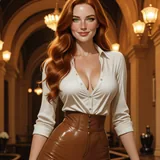
You typed a sentence you were happy with. What came back is adjacent to it — the right general idea, wrong in four specific ways. The hair color moved onto the dress. The room is a hotel lobby instead of an apartment. Nobody is standing where you said.
The reflex at that point is to add words. More adjectives, more "high quality," more insistence. That almost never works, because the problem usually isn't that you said too little — it's that the model read your sentence differently than a person would.
This guide closes that gap: what a text-to-image model does with your words, how to translate a feeling into something renderable, and how to work backwards from a bad image to the phrase that caused it. It's tool-agnostic — practice on our image generator in guest mode or anywhere else.
What the Model Actually Does With Your Sentence
It does not read your prompt. It converts it into a cloud of concepts and then pulls an image toward all of them at once. Three consequences explain most disappointing results:
Grammar barely survives. "A woman handing a glass to a man" and "a man handing a glass to a woman" land in nearly the same place. Word order carries weight; syntax — who does what to whom — mostly doesn't. Prefer one subject per image.
Negation doesn't exist. "No glasses" contains the concept glasses, so glasses get more likely, not less. Every noun is a request. Describe presence: "bare face, hair pulled back."
Attributes leak. This is the one that surprises people. In "adult woman with red hair in a green silk dress, gold earrings," the model knows red, green, and gold are in play but is fuzzy on which belongs to what. You get green hair, or red earrings, or a gold dress. Attribute binding is the single most common cause of "it ignored my prompt."
Three habits fix most of it: keep every adjective touching its noun, split the description into short comma-separated clauses instead of one long sentence, and cap yourself at two or three colors per image. A prompt with six colors is a prompt asking to be shuffled.
The Camera Test: Turning Intent Into Description
Most weak prompts are weak because they describe a situation rather than a photograph. "She's been waiting for me all evening and she's not thrilled about it" is a story. A model can't render backstory, mood-in-the-abstract, or the passage of time.
So apply the camera test: if a camera couldn't record it, it doesn't belong in the prompt. Convert each intangible into a visible fact.
| What you mean | What a camera sees |
|---|---|
| She's been waiting a while | coat still on, one shoe off, half-empty wine glass, looking toward the door |
| It's an intimate moment | close framing, single warm lamp, soft shadows, gaze into the lens |
| She's confident | chin level, shoulders back, hands relaxed at her sides, direct eye contact |
| Expensive taste | silk, tailored lines, marble surface, low gold light |
| Late night | dark window, lamp as the only light source, reflections on glass |
Two things worth stating in every single prompt, no exceptions. First, framing — "close-up," "half-body portrait," "full-body shot" — because with no framing word the model guesses, and that's how heads get cropped. Second, that your subject is an adult woman in her twenties, thirties, whatever you mean. Vague age language produces vague faces and is the fastest way to have a generation refused on any platform, ours included.
How Much Detail Is Enough
More detail helps until it starts competing. Each slot has a sweet spot:
| Slot | Too vague | About right | Too much |
|---|---|---|---|
| Subject | "a girl" | "adult woman, late 20s, long dark hair" | "adult woman, 27, dark hair, brown eyes, freckles, dimples, small scar, three rings" |
| Wardrobe | "nice dress" | "emerald satin slip dress, thin straps" | "emerald satin dress, lace trim, pearl buttons, matching belt, sheer overlay, boots" |
| Setting | "a room" | "dim apartment, unmade bed, window at left" | "apartment with bookshelves, plants, posters, laptop, coffee cups, guitar, cat" |
| Light | (omitted) | "single warm lamp from the left" | "candlelight and studio flash and golden hour" |
| Style | "good quality" | "cinematic photo, shallow depth of field" | "cinematic, anime, oil painting, 3D render, photoreal" |
The pattern in the right-hand column: every extra noun is another object the model must find room for, so detail past a point doesn't sharpen the image, it clutters it. Roughly one strong, unusual detail per slot beats five ordinary ones — "a chipped red nail" does more for realism than "beautiful hands, perfect skin, flawless."
And never mix two style families. "Cinematic anime" is a request for a muddy average of both.
Reading the Image You Got
The fastest way to improve is to stop guessing at rewrites and diagnose backwards. Nearly every failure maps to a specific thing in your text:
| What you're looking at | What in your text did it | Fix |
|---|---|---|
| Colors on the wrong items | Attribute leak — adjectives too far from their nouns | Adjective adjacent to noun; fewer colors |
| The thing you excluded is there | Negation ("no," "without") | Describe what is present |
| Head cropped, odd composition | No framing word | State the shot type first |
| Half the prompt ignored | Prompt too long; key words at the end | Move what matters to the first ten words |
| Plastic, airbrushed face | "beautiful, perfect, stunning, flawless" | Concrete nouns; add skin texture, real light |
| Looks like a stock photo | Only generic nouns — "room," "dress," "smile" | One specific, slightly odd detail |
| Two people when you wanted one | Plural or ambiguous phrasing, "mirror," "reflection" | Say "a single woman, alone in frame" |
| Garbled letters on a sign or shirt | You asked for readable text | Don't — models can't spell reliably |
Then change one slot per generation. Rewriting everything at once is why people burn twenty attempts and end up preferring result number two — no single run taught them anything. Also copy each prompt into a notes app before you regenerate: the text box is usually your only record, and the version you liked disappears the moment you overwrite it.
If your prompts run explicit, the structure is identical but the failure modes shift — our NSFW image generator guide covers that end specifically.
When Writing a Prompt Is the Wrong Tool
Sometimes you don't have a picture in your head to describe. You have a mood, and prompting from scratch feels like homework.
| You want | Better path |
|---|---|
| A precise image you can already picture | Write it yourself on /generate |
| A photo that fits a conversation you're in | Ask a character for one mid-chat |
| Ideas before spending a try | Browse the gallery and reverse-engineer what worked |
The middle row is the part hard to replicate with a prompt box. Intimora has six characters, and when you ask one for a photo the image is built from the scene you're actually in — not a random selfie from a folder. Ask Ayaka, a 36-year-old literature dean, for a picture while she's in her office at night and you get that office and that light. Ask Naomi, a 22-year-old fantasy illustrator with aqua-blue hair, mid-sketch and you get the sketch. The conversation writes the prompt for you. We broke that mechanism down in AI girlfriend that sends pictures, and the conversation side in NSFW AI chat. If you're comparing platforms first, best AI girlfriend apps covers how different ones handle images.
One Hard Boundary
Everything above is text to image: fictional adult characters, brought into existence by description. There is no upload field and no way to edit a photograph here, and that's deliberate rather than unfinished — tools that operate on photos of real people are a legal problem wearing a feature's clothing, in the US and increasingly everywhere else.
Practically, description is also just better. A character you wrote from words is one you can adjust, re-run, and refine slot by slot. That control is the whole reason text-to-image is worth learning.
FAQ
Do I need an account to generate an image from text? No. Guest mode on /generate gives you a prompt box and a few free images with no email, no password, and no card. The page shows what you have left before you spend it.
Why does the same prompt give a different image every time? Generation starts from random noise, and without a fixed seed each run takes a different path through your description. Use it deliberately: re-running an unchanged prompt two or three times often finds a better composition than a rewrite would.
How long should my prompt be? Twenty-five to fifty words covers almost everything. Past that, later words compete with earlier ones and the model starts dropping details. If a prompt feels long, cut adjectives, not nouns.
Can I upload a photo as a reference instead of describing it? No — the generator is text-only by design. Describe hair, build, wardrobe, pose, setting, and light in words, and you'll get more control than a reference image would have given you anyway.
Why do faces and hands come out worse than everything else? Both are things humans inspect closely and models render from an average, so small errors read as obvious. Framing helps more than adjectives: closer shots give the model more pixels for a face, and hands relaxed or out of frame beat hands doing something complicated.
What can't the model do, no matter how well I write the prompt? Reliable text in images, exact object counts, precise anatomy in complex poses, and consistent relationships between multiple people. Write around these rather than into them — one subject, simple pose, no lettering.