
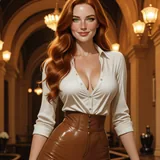
The "Photorealistic" Trap
You type "realistic beautiful woman, photorealistic, 8k, ultra detailed, masterpiece" and get back a glossy render. Plastic skin. A perfectly symmetrical face. A rim light coming from a source that doesn't exist in the scene. It's pretty. It is not a photo. And adding more realism words makes it worse — stack "hyperrealistic, ultra HD, sharp focus" on top and the image gets shinier, not more believable.
Here's why, and it's the most useful thing to understand about image generators: "photorealistic" is a style word, and style words are the weakest instruction you can give. Models learn from captioned images, and real photographs in that training data were rarely labeled "photorealistic 8k masterpiece" — they were labeled with facts: who is in the frame, where, wearing what, in what light, shot on what lens.
So you don't get a photo by asking for realism. You get one by describing the conditions a real photo would have been taken under. Everything below works on any text-to-image tool; if you want somewhere to test it immediately, the Intimora generator runs in guest mode with a few free images and no signup.
Build the Prompt in Four Layers
Stop writing prompts as one long adjective pile. Write them in layers, in this order — generators weight early tokens more heavily, so the subject goes first and the technical stuff last.
| Layer | What it answers | Example wording |
|---|---|---|
| 1. Subject | Who is she, physically? Always an adult woman. | "a woman in her late twenties, dark wavy hair, freckles across her nose, athletic build" |
| 2. Wardrobe & pose | What is she wearing, what is she doing? | "oversized grey t-shirt, sitting on the edge of an unmade bed, one knee pulled up" |
| 3. Environment & light | Where is she, and where is the light coming from? | "small apartment bedroom, late afternoon sun through a dusty window, warm shadows" |
| 4. Camera & capture | How was this photographed? | "35mm, shallow depth of field, natural skin texture, slight grain, candid" |
Put together:
a woman in her late twenties, dark wavy hair, freckles across her nose, oversized grey t-shirt, sitting on the edge of an unmade bed in a small apartment, late afternoon sun through a dusty window, 35mm, shallow depth of field, natural skin texture, slight grain, candid
Compare that to "realistic sexy woman, photorealistic, 8k." Same tool, completely different output — the second prompt gave the model nothing to anchor to, so it filled the gaps with its glossiest defaults.
Then swap out the vague words. Most bad prompts are built from adjectives that sound descriptive but carry no information:
| Instead of… | Write… |
|---|---|
| "beautiful lighting" | "single window light from camera left, soft shadow under the jaw" |
| "photorealistic" | "35mm photo, shallow depth of field, natural skin texture" |
| "detailed skin" | "visible pores, faint freckles, slight flush on the cheeks" |
| "nice background" | "cluttered kitchen counter behind her, out of focus" |
| "cinematic" | "warm bedside lamp as the only light, deep shadows" |
| "perfect body" | an actual description — height, build, proportions |
| "high quality" | (delete it; it does nothing) |
Notice the pattern: every replacement is something a photographer would have had to physically decide. That's the whole trick.
Five Mistakes That Quietly Kill Realism
1. Stacking quality tags. "8k, masterpiece, ultra HD, best quality, award winning" eats a chunk of your prompt and pushes the model toward its most over-processed look. Prompt space is finite — Intimora's box caps at 1200 characters — and every quality tag is a description you didn't write.
2. Style contamination. One stray word like "anime," "illustration," "artstation," "digital painting," or even "art" drags the whole image toward drawing. Realism prompts should contain zero art vocabulary. Same for "doll" and "porcelain" — those describe non-human surfaces.
3. Asking for perfection. Real faces are asymmetric; real skin has texture, redness, stray hairs, a shine on the nose. Requesting "perfect flawless skin" is explicitly asking for the plastic look you're complaining about. Ask for imperfection on purpose.
4. Leaving the light undefined. Say nothing about light and the model defaults to even, shadowless studio lighting — the fastest way to look synthetic. Name one source: window, lamp, streetlight, phone screen, overcast sky. One beats three.
5. Cramming too much in. Two people, a complex pose, hands doing something specific, and a busy background in one prompt is where anatomy falls apart. Portrait and half-body framing hold up far better than full-body action shots.
Worth knowing before you blame your own prompting: every generator has a native look baked into its checkpoint. Some are trained mostly on photographs, some lean illustrative. Prompt craft pushes a model toward its realistic end but can't turn one family of model into another — if output stays stylized no matter what you write, that's the checkpoint talking. Our NSFW AI image generator guide covers adult-oriented generation more broadly.
Realism Is in the Scene, Not the Face
Once the face and skin look decent, the thing still giving you away is usually the background. Generated scenes tend to be suspiciously tidy — empty rooms, clean surfaces, nothing out of place.
Real photos have junk in them. Add it deliberately: a mug on the nightstand, a towel over a chair, laundry on the floor, a crooked picture frame. Add wardrobe imperfection too — a slipping strap, a wrinkled shirt, hair that isn't perfectly styled. Two or three of those beat any amount of "ultra detailed."
Framing helps as well. "Shot from slightly below eye level," "seen from the doorway," or "looking off-camera, not at the lens" read as photographic because they imply a photographer standing somewhere specific.
Getting the Same Woman Twice
Here's the hard limit of a standalone generator: each prompt produces a new person. Change one word and her face changes. The partial workaround is a character sheet — a fixed sentence covering age, hair, eyes, build, and one distinctive marker like a tattoo or freckle pattern, pasted identically every time, with only the scene layer changing beneath it. That gets you into the same neighborhood, not the same person.
For real consistency you need locked characters. Intimora has six adult women whose appearance is fixed — Ayaka (36, a university dean), Alexa (25, a fashion model), Naomi (22, a fantasy illustrator), Valeria (29, who runs a private club in Milan), Sienna (27, a countryside heiress), and Goddess (30, a professional dominatrix) — and their photos follow the scene you're actually in instead of returning a random selfie, which we broke down in AI girlfriend that sends pictures. If you're still comparing platforms, our best AI girlfriend apps roundup covers the trade-offs.
Iterate Like a Photographer
Change one variable at a time. Same subject, three lighting setups. Then the best lighting, three framings. Then the best framing, three wardrobe options. It feels slow and it's roughly ten times faster than rewriting the whole prompt every attempt, because you learn which word did what. Keep the winners in a text file — within a week you'll have reusable blocks for lighting, skin, and camera, and prompting stops being guesswork.
FAQ
Why do my AI images look like drawings even when I write "photorealistic"? Usually one of two reasons: the prompt contains art vocabulary ("illustration," "digital art," "anime," "artstation") that outweighs the single realism word, or the model's checkpoint has a stylized native look. Delete every art-related word first, then add camera and lighting language instead of realism adjectives.
What makes AI skin look plastic, and how do I fix it? Requests for perfection. "Flawless," "smooth," "porcelain," and "perfect" all push toward an airbrushed surface. Replace them with texture words — visible pores, faint freckles, slight redness, a small mole — and define one directional light. Flat, shadowless lighting is what makes skin read as rendered rather than photographed.
Do camera terms like "35mm" actually do anything? Yes, though not as physics. The model learned those terms from photo captions, so they act as a shortcut to the whole look those captions came with: shallow depth of field, natural compression, real-world framing. "Shot on 35mm, shallow depth of field" beats "photorealistic, 8k" consistently.
How long should a realistic prompt be? Roughly 40 to 70 words. Shorter and the model improvises with its defaults; much longer and the later details get diluted. If you're near the character limit, cut quality tags first, never scene description.
Can I generate realistic images without creating an account? On Intimora, yes — the generator works in guest mode with a small number of free images per day and no email required. A free account is what keeps your daily allowance and gallery tied to you.
Are there things a realistic AI girl generator won't do? Yes, and these are hard limits rather than settings. Intimora generates fictional adult characters from text descriptions only. It does not process uploaded photos of real people, will not produce likenesses of real individuals, and blocks any prompt suggesting a minor.
Try It
Take one of your old flat-looking prompts, strip the quality tags, add a light source and a lens, and drop a piece of clutter into the background. Then run it on the Intimora generator — no signup, results in seconds. If you want a character whose face stays the same from one photo to the next, start a chat and ask her for a picture mid-scene.