



The Problem Nobody Warns You About
You type a prompt. You get a beautiful image. You like her. So you type almost the same prompt again to see her in a different outfit — and a completely different woman shows up. Different face, different hair, different body. Seven attempts, seven strangers, instead of seven photos of her.
This is the most common frustration with any AI girlfriend photo generator, and it isn't the generator being bad. It's a prompt problem, and it's fixable in about two minutes.
Everything below is about generating fictional characters from text descriptions — the only thing Intimora's generator does. No uploading photos of real people, no editing real images. Adults 18+ only.
Why Every Generation Gives You a New Woman
Two things are working against you.
1. The image starts from fresh random noise every time. Give the model a vague prompt and that randomness decides everything you didn't specify. "Beautiful woman in a red dress" leaves face, hair, build, age, and skin tone up to chance — so chance delivers a new person each run.
2. The model fills gaps with the average of its training data. Anything you leave blank becomes the statistically most common answer, which drifts run to run. This is why people say the generator "changed her." It never had her. It had a red dress and a guess.
The fix is unglamorous: the character has to live in the text. If you didn't write her down, she doesn't exist between generations.
Build a Character Card Once, Reuse It Forever
Stop writing prompts from scratch. Write one identity block — a fixed, copy-pasteable string of the traits that make her her — and paste it at the front of every prompt for the rest of her life.
A working identity block for a fictional character:
adult woman, 29 years old, olive skin, long dark wavy hair with a center part, deep brown eyes, high cheekbones, small beauty mark under her left eye, red lipstick
That's it. Eight tokens, no scene, no outfit, no lighting. Now every prompt becomes identity block + whatever you want today:
adult woman, 29 years old, olive skin, long dark wavy hair with a center part, deep brown eyes, high cheekbones, small beauty mark under her left eye, red lipstick, sitting on a velvet armchair, black silk slip dress, one strap slipping, warm lamplight, apartment at night, three-quarter view, cinematic, high detail
Two rules that matter more than they look:
- Copy-paste it, never retype it. Retyping is how "wavy dark hair" quietly becomes "dark wavy hair" and the face shifts. Keep the block in a notes app.
- Include an explicit adult age. "Adult woman, 29" isn't just legal hygiene — it's a real consistency anchor. Left unstated, the model's guess wanders.
Pick rare anchors, not common ones
Not all traits hold equally. "Brown hair, blue eyes" is the most common description in the training data, so it constrains almost nothing — millions of different faces satisfy it. Unusual, specific, visually loud traits act like handles the model can grip:
| Weak anchor (drifts) | Strong anchor (holds) |
|---|---|
| brown hair | long aqua-blue hair, blunt bangs |
| pretty face | freckles across nose and shoulders |
| nice eyes | bright green eyes, dark eyeliner |
| slim | athletic build, broad shoulders, long legs |
| tattoo | small geometric wolf tattoo on left ribcage |
| glasses | thin gold reading glasses on a chain |
Two or three rare anchors do more for consistency than ten generic adjectives. And there's a ceiling: past roughly ten identity tokens they start competing with each other and the face gets muddy rather than more precise. Trim, don't pile on.
Token Order: Identity First, Scene Second
This one is counterintuitive and it cost us a production regression to learn. The models behind most AI girl generators weigh earlier tokens more heavily. Put the scene first and the scene wins — the character gets averaged away.
We had this exact bug internally. Composition tags were emitted before the character description, and a character with distinctive blue hair kept coming out blonde. Same prompt, same model, only the order changed. Identity-first fixed it.
So use a fixed slot order:
| Slot | What goes here | Example |
|---|---|---|
| 1 | Identity block (never changes) | adult woman, 27, red wavy hair, green eyes, freckles |
| 2 | Outfit | oversized cream sweater, no bra |
| 3 | Pose / action | lying on her side, looking up at the camera |
| 4 | Setting | country house bedroom, morning light through curtains |
| 5 | Camera / framing | close-up, three-quarter view, shot from above |
| 6 | Style / quality | photorealistic, sharp focus, cinematic lighting |
The one exception: if the pose is the whole point of the image and the generator keeps giving you a polite portrait instead, move the action tag to the very front for that generation. Composition-first beats identity-first when the composition is what's failing. Just expect a small hit to facial consistency in those frames.
Five Mistakes That Break Consistency
Writing paragraphs instead of tags. Long flowing sentences ("she is a woman who has the kind of eyes that...") get compressed into mush. Comma-separated descriptive tags land far more reliably on the illustration and photoreal checkpoints these generators run on.
Contradicting yourself mid-prompt. "Long hair, short bob" or "athletic, delicate and tiny" forces the model to average two answers into something you didn't ask for. Read your prompt back and delete every conflict.
Changing the identity block "just a little." Swapping one word to see what happens is fine — but that's a new character. If you liked run #4, the block from run #4 is the asset. Save it.
Stacking quality words instead of description. "Masterpiece, best quality, 8k, ultra detailed, award winning, trending" adds nothing after the first couple of terms, and it eats the attention budget your face description needs. On Intimora's generator the quality floor and safety negatives are applied server-side anyway, so you can spend your whole prompt on content.
Expecting hands and complex poses to be clean. They aren't, on any platform, in 2026. Fingers, overlapping limbs, and unusual angles are still the weak spot of every model on the market. Generate a few variations and keep the good one — that's what everyone doing this seriously actually does. If you want the deeper prompting walkthrough, see our NSFW AI image generator guide.
When to Let the Chat Carry the Character Instead
There's a second route to a photo of a specific woman, and it removes the prompt work entirely.
In a conversation, the character already is someone — a fixed look, a fixed personality, and a scene the two of you built. Ask her for a photo and Intimora's pipeline reads that same scene state: who she is, the mood, the setting, and what you actually asked for. Her identity is held between generations by the system, not by your notes app. That's the difference between a random pretty picture and a picture of her, and it's what we cover in AI girlfriend that sends pictures.
There are exactly six characters, each with a look that stays put across photos:
- Ayaka — 36, university dean in the literature department. Composed, intellectually dominant.
- Alexa — 25, fashion model and brand owner, aspiring designer. Direct and competitive.
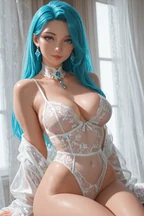
- Naomi — 22, fantasy illustrator in Paris. Warm, romantic, aqua-blue hair.
- Sienna — 27, heiress running a countryside estate and its private library.
- Valeria — 29, owner of a private members' club and art gallery in Milan.
- Goddess — 30, professional dominatrix and private fetish club owner.
Practical split: use the standalone generator when you want a woman you invented and full control over every token. Use chat when you want photos that follow a story you're already in. Browse the gallery if you just want to see what the model's output actually looks like before spending a generation.
FAQ
Why does the AI girlfriend photo generator give me a different woman every time? Because each generation starts from fresh randomness, and anything your prompt doesn't specify gets decided by that randomness. Write a fixed identity block — age, skin tone, hair, eyes, one or two distinctive marks — and paste it at the front of every prompt. Consistency comes from the text, not from the button.
How long should the identity block be? Six to ten tokens. Fewer than five and the model has too much freedom; more than ten and the traits start competing and the face gets muddy. Two or three unusual traits beat ten generic ones.
Should I write prompts as sentences or as comma-separated tags? Tags. Short descriptive phrases separated by commas land much more reliably than flowing prose, because the checkpoints these generators use were trained on tag-style captions. Keep each tag to a few words.
Do I need an account to generate images? No. The generator works in guest mode with a limited number of free images, no email and no signup. Adults 18+ only.
Can I upload a photo of a real person and generate images of her? No, and you shouldn't try anywhere. Intimora is text-to-image only — it creates fictional adult characters from written descriptions. Generating sexual images of real, identifiable people without consent is illegal in the US and elsewhere, and it's blocked here.
Which gives better photos of a specific character — chat or the standalone generator? Chat, if the character is one of the six: the system holds her identity and the scene for you, so nothing drifts. The standalone generator wins when the woman is your own invention and you want control over every token. Many people use both, and there's a broader comparison in our best AI girlfriend apps roundup.
Start With One Character
Don't try to get a perfect image on the first attempt. Write one identity block, generate four times with only the outfit changing, and see whether her face holds. If it drifts, your anchors are too generic — swap one for something rare and try again. That loop takes five minutes and it's the whole skill.
Open the generator — free to start, no signup, 18+ only.